
Unity Engine · C# · Virtual Reality · Hand Tracking · Haptics
SkinHaptics — CHI 2025, Acknowledged Implementation Contributor
Unity-side soft-object deformation and hand-tracking interaction components for a CHI 2025 VR haptics study.
Research Context
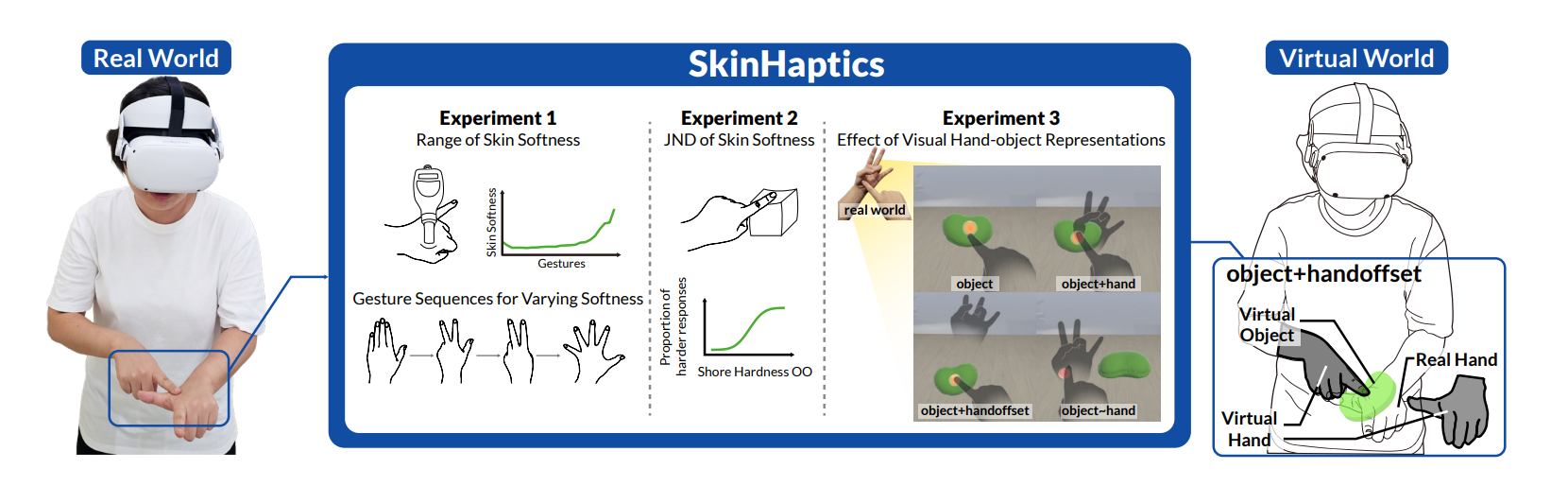
SkinHaptics is a CHI 2025 haptics study exploring how softness feedback can be presented in VR through the user’s own skin and virtual hand representation.
- The study investigates a device-free approach to haptic feedback, where visual deformation and the user’s own hand and skin are used to create a perceived softness experience.
- Because the study relied on virtual-hand interaction, the VR scene needed objects that could visibly deform when touched and respond to tracked hand gestures.
- The Unity environment had to turn these interaction ideas into testable VR behaviors.
My Contribution
I contributed as an acknowledged contributor by implementing Unity-side interaction components for the SkinHaptics experiment.
- Implemented mesh deformation for soft virtual objects by updating vertex positions during finger-object collision, using distance-based force attenuation, restoration force, damping, and adjustable deformation parameters.
- Built hand-gesture-triggered object placement using Oculus SDK hand tracking, including Active State / Shape Recognizer conditions and Hand Skeleton-based target positions.
- Implemented object-placement logic that attaches virtual objects to specified hand positions and rotates them to match the hand’s orientation, so objects could appear naturally placed on the virtual hand during gesture-triggered events.
Output
This work contributed to the experimental implementation of SkinHaptics, which was accepted to CHI 2025.
- Paper: SkinHaptics: Exploring Skin Softness Perception and Virtual Body Embodiment Techniques.
- Venue: CHI 2025.
- Credit: acknowledged contributor in the paper’s acknowledgement section.
Demonstration
The demonstration shows the experimental environment and soft-object interaction behavior.